
A Test of Strategy: A Deep Analysis of Rules, Players, and the Commercial Structure of Kabaddi
कबड्डी दक्षिण एशिया का एक पारंपरिक संपर्क खेल है जो आज पेशेवर और व्यावसायिक रूप ले चुका है। यह 13×10 मीटर के मैदान पर 7-7 खिलाड़ियों की टीमों के बीच खेला जाता है, जिसमें रेडर विपक्षी आधे हिस्से में जाकर अंक बनाता है। खेल के प्रमुख नियमों में रेड (30 सेकंड), कैंट (लगातार उच्चारण), टैकल, बोनस लाइन, ऑल आउट, डू-ऑर-डाई रेड, सुपर टैकल और सुपर रेड शामिल हैं। मुख्य प्रतियोगिताओं में एशियाई खेल, एशियाई चैंपियनशिप और प्रो कबड्डी लीग (PKL) शामिल हैं। भारत अंतरराष्ट्रीय स्तर पर प्रभावशाली है, ईरान निकटतम चुनौती देने वाला देश है, और PKL भारत का सबसे सफल गैर-क्रिकेट व्यावसायिक लीग मॉडल है। खेल की चुनौतियों में खिलाड़ियों की चोटें, शासन अस्थिरता, महिला लीग का अभाव और ओलंपिक बोली की विफलता शामिल हैं।
Kabaddi, often called the 'sport of the soil' of South Asia, is today a professional, television-driven industry. This article presents a systematic analysis of the sport's rules, player strategy, competitive landscape, cultural context, commercial model, governance structure, risk factors, and public narrative.
1. Sport and Rules Analysis
Kabaddi is played on a 13m × 10m court between two teams of seven players each. One player at a time, called the 'raider', enters the opponent's half while continuously chanting 'kabaddi-kabaddi'. This chant, known as 'cant', is proof that the raider is not holding his breath; if the chant breaks, the raid is void. During a raid, the raider must touch one or more defenders and return safely to his own half within 30 seconds. Each successful touch earns one point. Meanwhile, the collective action of defenders is called a 'tackle', where they stop the raider in their own half to earn a point.
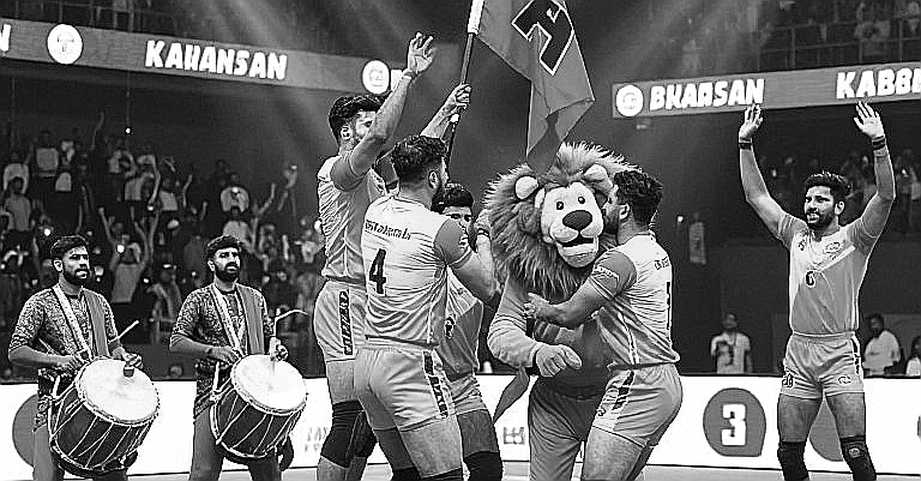
Beyond these basic rules, several provisions heighten the game's pace and drama. The 'bonus line' is a line drawn deep in the opponent's half; crossing it earns one point, but only when the defending team has six or more players on court. An 'all out' occurs when all seven players of one team are dismissed; the opposing team receives two bonus points and the entire dismissed team is revived. In a 'do-or-die raid', after two consecutive empty raids, the third raid becomes mandatory-scoring; failure results in the raider himself being dismissed. A 'super tackle' occurs when the defending team has three or fewer players and they complete a tackle; it earns two points instead of one. A 'super raid' generates three or more points in a single raid. These three elements—the risk of do-or-die, the temptation of the bonus line, and the revival of the all out—together create kabaddi's signature 'fast scoring, frequent comebacks' tempo, which is precisely why the sport is ideal for prime-time television.
Matches are played in two 20-minute halves. At the professional and international level, 'Standard Style' is used, while 'Circle Style' prevails in rural Punjab and other regions. The two styles differ in court dimensions and scoring details.
2. Player and Team Tactical Analysis
Players in kabaddi can be broadly grouped into three roles: raiders, defenders, and all-rounders. The raiding core is the team's primary scoring engine. A top raider is identified by their 'successful raid percentage', average points per match, number of super raids, and do-or-die raid conversion efficiency. Looking only at total points can be misleading; efficiency metrics are more important. The defensive core comprises specialists at corner, cover, and in positions, and the team's 'tackle success percentage' is a direct indicator of defensive strength.
When assessing team balance, it is essential to see whether the scoring burden rests on a single star raider. If a team's wins depend largely on one player's performance, the entire structure can collapse if that player is injured or loses form. Similarly, bench depth determines how durable a team is over a long tournament. Rebuilding teams through auctions and drafts is a process that constantly involves trade-offs between balance and continuity.
3. Competition System and Landscape
At the international level, kabaddi's structure is broadly moving from 'unipolar to bipolar'. India has historically been dominant, Iran is the established challenger—having proven it can beat India by winning men's gold at the 2026 Asian Games—while South Korea, Bangladesh, and Pakistan are in the catch-up or style-specialist tier. Domestically, the Pro Kabaddi League (PKL) is a multi-power structure, with dynastic franchises like Patna Pirates coexisting with newer contenders. The auction and draft mechanism is the designed lever for maintaining competitive balance.
In the prestige hierarchy, the Asian Games sit at the top, followed by the Asian Championship and commercial invitational tournaments, while PKL is a separate professional tier. Whether the strength gap between teams is widening or narrowing, and whether the India-Iran duopoly is solidifying, are questions that depend on season-by-season data.
4. Regional Landscape and Cultural Background
India's dominance in talent supply is clear. Haryana, Maharashtra, Punjab, Uttar Pradesh, and Tamil Nadu are the main talent states. The 'Akhada' system provides a deep grassroots base. Iran is the nearest challenger due to its wrestling and power-tradition sports culture. In Bangladesh, kabaddi is the national sport, with a deep grassroots base but lagging commercialisation. South Korea is advancing through systematic training and its players' participation in PKL. Pakistan specialises in Circle Style, and intense nationalist sentiment is seen in matches against India. Sporadic development is occurring in countries like Nepal, Sri Lanka, and Kenya.
Culturally, kabaddi's social meaning rests on three narratives. First, the claim of roughly 4,000-year-old indigenous origins, positioned as a 'born of the soil' sport against the 'colonial' nature of cricket. Second, class mobility—most players come from poor rural families, and absorption into government jobs (railways, police, army) incentivises them to stay in the sport. Third, the gender dimension—women's kabaddi has gained a place in the Asian Games but lacks a professional league like the men's; PKL remains men-only.
5. Commercialisation and Media Ecosystem
PKL's revenue model relies primarily on media rights, which have historically been concentrated with the Star/Disney Star network. Other revenue sources include title sponsorship, ticketing, and licensing. Franchise teams are owned mainly by Indian corporate groups and entertainment figures. The player auction is the sport's key price-discovery mechanism, with base prices set by grade (A/B/C/D) and a separate pool for overseas players.
When evaluating purchase prices at auction, one should see whether the price matches the player's recent performance. The risk of spending a large sum on a star player is that if he is injured or loses form, the investment will not yield returns. In team-building strategy, it is important to balance immediate results with long-term stability.
Claims of kabaddi's 'global' reach should be viewed cautiously. Overseas audiences and rights revenue are largely limited to the Indian diaspora. Domestic enthusiasm is high, but risks exist such as viewer-novelty decay, dependence on a single broadcaster, and auction salary bubbles.
6. Governance Rules and Institutional Analysis
The governance structure of kabaddi has the International Kabaddi Federation (IKF) at the top, the Amateur Kabaddi Federation of India (AKFI) domestically, and Mashal Sports operating PKL. Historically, AKFI has been mired in controversies, including administrative crises and judicial intervention. Kabaddi's bids for the Tokyo and Paris Olympics failed, mainly due to falling short on global participation spread and women's game criteria.
When assessing governance risk, the stability of the federation is the most important indicator. Turmoil in the federation can directly affect the suspension of events and national team participation. Anti-doping, refereeing standardisation, and athlete protection are also areas requiring continuous monitoring. Incentive structures such as government job absorption and the Arjuna Award are important for retaining players in the sport.
7. Risk Landscape
Among competitive risks, injury is the most prominent. Kabaddi is a high-contact sport where knee, ankle, and shoulder injuries are common. Scoring dependence on a single raider is a major risk for a team. Stylistically, aggressive raiding teams can be troubled by disciplined defensive units.
Commercial risks include excessive prices at auction, single-company control over broadcast rights, and declining audience interest. Governance risks include AKFI instability and the failure of Olympic bids. Public opinion risks include rising nationalist sentiment and off-field incidents.
Professional risks include issues such as grassroots income, training science, women's sport, and retirement security. Urbanisation is shrinking the rural kabaddi pipeline, raising questions about long-term talent supply.
8. Public Narrative and Expectations
The most common narratives in kabaddi coverage are—national pride ('India's sport conquering the world'), grassroots ascent ('village boy becomes PKL star'), dynastic succession ('next Pardeep'), revenge ('India-Pakistan, India-Iran'), and Olympic heartbreak.
When assessing narrative sustainability, one should see whether fundamental data supports the narrative. Labels like 'next Pardeep' are often applied early, while the historical fulfilment rate of such labels has been low. In the case of a young raider, making big claims based on a few matches and later colliding with statistical reality is a predictable risk.
Observing the ratio between social media enthusiasm and fundamental data is an important indicator. If enthusiasm far outstrips fundamental performance, it may signal a bubble.
9. Industry Transmission Analysis
PKL is considered India's most successful non-cricket commercialisation case—a combination of franchises, auctions, and prime-time broadcasting. Its template has been imitated with mixed results by badminton, wrestling, volleyball, and table tennis leagues.
According to the value chain, upstream is grassroots development and youth training, midstream is PKL and national team events, and downstream is broadcasting, sponsorship, and derivative products. Whether kabaddi's success genuinely boosts rural participation is a critical question. The movement of athletes from other sports (such as wrestling and judo) into kabaddi and the growth of fantasy sports platforms' (such as Dream11) kabaddi verticals are signal areas to monitor.
Summary and Conclusion
Kabaddi is a sport that has emerged from traditional rural roots to gain a professional and commercial stage. Its strength lies in its fast, dramatic format, ideal for television, and its deep cultural roots that create emotional connection with audiences. Its challenges are also clear—player safety, team balance, governance stability, women's sport development, and international expansion.
For the future, kabaddi needs to focus on three directions. First, prioritise player welfare and injury management so the sport's appeal is sustained. Second, restore federation credibility through governance reform, which is a prerequisite for Olympic bids and international expansion. Third, build a professional platform for women's kabaddi, so that half the sport's potential can be utilised.
Kabaddi's story is still unfolding. It shows how a local sport can forge an identity on the global stage, and it also shows how many obstacles lie on this path. Its future will depend on whether stakeholders—players, teams, federations, broadcasters, and fans—can together build a sustainable ecosystem.