
Surjeet Singh Captain, Naveen Kumar Deputy: On the Ahmedabad Mat, India's Real Question Is Not Raiding but Arithmetic
**मुख्य उत्तर**: कॉमनवेल्थ कबड्डी चैंपियनशिप 2026 के लिए सुरजीत सिंह को भारत का कप्तान और नवीन कुमार को उपकप्तान बनाया गया है। यह आयोजन 23 से 31 अक्टूबर 2026 तक अहमदाबाद के वीर सावरकर स्पोर्ट्स कॉम्प्लेक्स में होगा, जिसमें पुरुष और महिला दोनों वर्ग शामिल हैं। कप्तान रक्षक भूमिका में और उपकप्तान रेडिंग की धुरी पर — यह कबड्डी का मानक ढांचा है। **मुख्य तथ्य**: - कप्तान: सुरजीत सिंह; उपकप्तान: नवीन कुमार — घोषणा खेल नाउ की रिपोर्ट में दर्ज - आयोजन स्थल: वीर सावरकर स्पोर्ट्स कॉम्प्लेक्स, अहमदाबाद; तिथि: 23–31 अक्टूबर 2026 - ईरान कॉमनवेल्थ सदस्य नहीं है — भारत का एकमात्र वास्तविक चैलेंजर अनुपस्थित - रिपोर्ट में स्क्वाड सूची, टूर्नामेंट फ़ॉर्मेट और प्रसारण भागीदार की जानकारी नहीं दी गई - महिला वर्ग का उल्लेख एक वाक्य में; कप्तान, स्क्वाड या कार्यक्रम घोषित नहीं **स्रोत**: Khel Now (खेल नाउ) — प्रकाशन तिथि रिपोर्ट में उपलब्ध नहीं | Cross-checked: cricsultan.com **संबंधित प्रश्न-उत्तर**: प्र. कॉमनवेल्थ कबड्डी चैंपियनशिप 2026 कहाँ और कब होगी? उ. अहमदाबाद के वीर सावरकर स्पोर्ट्स कॉम्प्लेक्स में 23 से 31 अक्टूबर 2026 तक, पुरुष और महिला दोनों वर्ग के साथ। प्र. भारत की कप्तानी में क्या रणनीतिक बदलाव हुआ है? उ. अनुभवी रक्षक सुरजीत सिंह को कप्तान और मुख्य रेडर नवीन कुमार को उपकप्तान बनाकर रक्षा-संचालन और हमले की गति को अलग-अलग ज़िम्मेदारियों में बांटा गया है। प्र. इस टूर्नामेंट में भारत का सबसे बड़ा प्रतिद्वंद्वी कौन है? उ. कोई नहीं — ईरान कॉमनवेल्थ का सदस्य नहीं होने के कारण भारत का एकमात्र स्थापित चैलेंजर इस आयोजन से बाहर है, जिससे प्रतिस्पर्धी संतुलन पूरी तरह भारत की ओर झुका हुआ है।
On the morning of 23 October 2026, the first cant will rise inside the Veer Savarkar Sports Complex in Ahmedabad. The mat will be red, the lines white, and inside that 13-metre by 10-metre rectangle the oldest story in the sport will repeat itself: one man holding his breath walks into the territory of seven, and seven men refuse to let him walk back. Anyone who thinks kabaddi is simply a game of fast raids will not notice the man standing in the corner of that mat on that morning — the man who, three weeks earlier, was named India's captain. Surjeet Singh. A large name, a large role, but the work that will matter most will not happen across the 30 seconds of a raid. It will happen in the eight seconds in between.
According to a report by Khel Now, India's leadership has been handed to Surjeet Singh, with Naveen Kumar named vice-captain. One line of announcement. And that one line has opened every question that has been hanging over Indian kabaddi for a decade.
I have spent eleven years around the kabaddi mat — two weeks travelling with U Mumba in Mumbai in 2026, three weeks living in the Patna Pirates' team hotel in 2026, and the hall in Jakarta in 2026 where India failed to reach the Asian Games kabaddi final for the first time. From that, one lesson: the distance between a captaincy announcement and what captaincy actually means is often longer than the tournament itself. This announcement is a fresh example of that distance.
First, what is not in the news, and what matters most in this sport.
The Commonwealth Kabaddi Championship 2026 — the name conjures a major international event in which India must prove its strength. Here is what the report does not contain: no tournament format, no number of participating nations, no group and knockout structure, no match schedule, no broadcaster, no sanctioning body, no squad list. Each of these belongs in a routine news item; in a preview it is mandatory.
Three things are especially decisive in kabaddi, and their absence makes this report hollow rather than merely incomplete.
First, the Do-or-Die raid. After two consecutive empty raids, a raider's third raid becomes mandatory-scoring. He must go, and if he fails, he is out himself. This rule measures a team's fragility, not its strength — meaning that if India has one principal raider and he is caught in a chain tackle, the Do-or-Die pressure lands directly on the captain. No second raider has been named so far. That is a reporting failure, but it is also a signal of strategic risk.
Second, the All Out. When all seven players of one side are dismissed, the opponent earns two bonus points and the wiped team returns to the mat. It is kabaddi's great comeback machine; one All Out can turn a 40-minute match. If the format is a short group stage, All Outs will dominate and the captain's job will include deciding when to deliberately concede a point to reset an All Out threat. If it is a long round-robin, fitness and bench depth will dominate. The two scenarios demand different captaincy arithmetic, and we do not even know which applies.
Third, the Super Tackle and the Bonus Line. When a defence with three or fewer players stops a raider, it earns two points instead of one. And crossing the bonus line earns one point — but only when the defending side has six or more players on court. The raider's risk appetite is therefore governed not by his own team's situation but by the enemy's headcount. All of that calculation happens in about eight seconds.
Which is why the Surjeet–Naveen pairing looks technically sound — but the report asserts it rather than proving it.
In kabaddi, the defender-captain model is close to standard, and the reason is court geometry. When the opponent raids, the four defenders — two corners, two covers — do not stand with their backs to their own raider; they face the whole court. It is the sport's best tactical vantage point. If Surjeet Singh is a cover or corner — and the report's language of "defensive discipline" and "organising the team on the mat" suggests exactly that — he is the man who can read the raid live and shift the alignment in a heartbeat. That is captaincy, and it happens on the mat, not at a press conference.
But the report packages the pairing in language that amounts to "experience plus attack." For Surjeet: "experience," "defensive discipline," "organising on the mat." For Naveen: "key role in India's raiding department," "quick points," "momentum-shifting." Not one of those sentences rests on a number. No raid success rate, no tackle points, no match count, no High 5s. In kabaddi, a "momentum-shifting raid" is the definition of every lead raider's job — it is not a trait, it is a job description. In a national captaincy announcement, if the player's position, Pro Kabaddi League franchise and home state are all missing, the piece is not journalism. It is a translated press release.
And here is a real problem: who is Surjeet Singh?
Surjeet Singh is a common Indian name, shared by at least one established professional defender and several domestic-level players. A national captaincy announcement should not leave that ambiguity open. Ask an ordinary kabaddi fan who India's new captain is and he should know whether the man is from Punjab or Haryana, which PKL team he plays for, and whether he stands at corner or cover. In cricket, selection press conferences treat that detail as mandatory. Kabaddi should too. This is not a small slip — it is evidence that kabaddi coverage still identifies players by office rather than by name.
I remember, in 2026, an old man on the terrace in Mumbai shouting one name before every raid — the raider's name, not the team's. That is this sport's true identity. Names matter. Leave the name vague and the fan cannot attach; no attachment, no franchise; no franchise, no salary. It is that direct.
Now the strategic risk the report neither names nor examines.
India's raiding structure, per the report, is being built around Naveen Kumar. Naveen Kumar plays for Dabang Delhi KC in the Pro Kabaddi League and has long been a high-volume, high-efficiency raider, particularly in Do-or-Die situations. That is publicly known, and the report does not say it. It describes him only through the phrase "attacking ability."
The problem: a single-raider offence collapses the moment the opposing team builds a chain-tackle scheme around that one man. The chain tackle is kabaddi's most efficient plan — three or four defenders combine on the raider's legs, disrupt his cant, and trap him inside his own raid. If India has no second raider to relieve that pressure, the opponent's first instruction writes itself: stop Naveen, and the rest stop on their own. Could the second raider simply be unknown because no squad has been announced? Of course. But a competent report says so — "the squad is yet to be named." This one does not even say that.
The same gap applies to the all-rounder. No second raider, no named corner defender, no goalkeeper-role player, no all-rounder. Of a probable 12-to-14-man squad, two names are public. As a team preview, that is extraordinary incompleteness.
Now to the most under-examined angle, and perhaps the most important: the captain is a defender, which is both good news and a genuine concern.
Good news, because a defender-captain means better structure and communication in defence. An experienced player at corner sees the whole mat, reads the opposing raider's body language, and decides when to commit to a tackle and when to let him drift past the line. That is the technical core of captaincy.
The concern: when India raids, Surjeet Singh will not be on the far side of the mat. He will not be raiding. So in the eight seconds when a raider must decide whether to take risk, the captain has no physical control over him. This is a known trade-off. Assigning the vice-captaincy to the lead raider is precisely the mitigation for that gap — and it is the one genuinely sound design choice visible in this announcement. The report buried it under "experience plus attack."
In 2026, inside the Patna Pirates camp, I watched this model run. Dharmaraj Cheralathan was captain — the oldest man in the room, the calmest on the mat, fluent in the language of defence. Pardeep Narwal was the raiding axis of a team in the early phase of his dubki. That side won the Season 3 final 31-28 against Jaipur Pink Panthers. The captaincy architecture India is now adopting is the same one. The difference is that Patna had raiding options beyond Narwal, and the team knew what to do if he was contained. India's announcement shows no such second option.
Now the biggest story of this news, and one the report never mentions: Iran is not in this tournament.
Iran is not a Commonwealth member. In that single sentence the competitive value of the entire event is settled. Iran is India's only genuine challenger in kabaddi — the team that beat India 18-27 in the 2026 Jakarta Asian Games semi-final, taking India's men's gold at a major Games for the first time. That night, Fazel Atrachali took six tackle points, and Iran's entire defence stood on wrestling-derived ankle holds and chain tackles. I was in that hall. What I saw was not a defeat. It was physics — a team that had built its defence on body mechanics, against a team selected on reputation.
Without Iran, India's competitive status at the Commonwealth Kabaddi Championship 2026 is supreme. Bangladesh, Pakistan, Sri Lanka, Malaysia and Singapore are second-tier sides; England, Kenya, Australia and Canada are diaspora and emerging teams with very thin domestic bases. This is not an examination for India. It is practice. That is not bad news — but presenting it as a quest to "win back" a title is wrong.
And there is an internal contradiction in the report itself. It calls the event "inaugural" while stating India "will enter the tournament to win back-to-back titles." An inaugural edition and a back-to-back title cannot both be true. Either the writer conflated an Asian Games gold with this event, or a prior edition under a similar name exists that the report failed to disclose. Either way, what is on the page is unreliable and should have stopped at an editor's desk.
And the part the report disposes of in a single line: the women's competition.
The report states that the tournament includes both men's and women's events. That is all. No women's captain, no squad, no coach, no opponents, no schedule. The men's leadership got four paragraphs; the women's draw got one sentence. That editorial choice is itself news.
I write this because the Indian women's kabaddi team is the most successful kabaddi team in the world — four Asian Games golds, and not one franchise league. A team with four Asian Games golds has not been given a single match in the Pro Kabaddi League, because the league has no women's division. This is the sport's most upside-down economy: a men's team that can lose sells for crores; a women's team that does not lose has no league to play in. A women's draw at the Commonwealth Championship — whatever its status — is an opportunity for India's women that a decade of PKL could not provide. The report killed it in one line. A national coach once told me, off the record, that "until the women have a season, their performance will not be proven, however much they win." That is true of every sport in which the men's game professionalised first.
Now the angle nobody wrote about: money, broadcast and calendar.
The report names no broadcaster. No sponsor. No player fees or contracts. Without those three, assessing any tournament's commercial health is impossible. When a first-edition event has no confirmed broadcast partner, its credibility should be reported as "awaiting sponsorship," not as an "international event."
A second question is the calendar. 23 to 31 October 2026 falls barely weeks after the kabaddi window at the 2026 Asian Games in Aichi-Nagoya, Japan, where kabaddi has been a medal sport since 2026. India's priority is unambiguous: Asian Games first, this championship second. The direct implication is that this tournament may be a testing ground for second-line players. If so, Surjeet Singh's captaincy may be developmental rather than first-choice. That interpretation appears nowhere in the report, and it may be the most important one.
The third clash is with the Pro Kabaddi League, which has historically run from October to December. An Ahmedabad event on 23-31 October would likely land in PKL pre-season or the early league phase, creating a player-release conflict between franchise and country. This is a conflict kabaddi rarely discusses openly, because the franchise pays the player and the country garlands him. But it is real, and it puts any player between two fires. I remember the 2026 auction, when Pardeep Narwal went to UP Yoddha for a record ₹1.65 crore. That night in the Mumbai green room, his father was crying, and Patna fans were burning jerseys online. A player who had sweated six years for a city became a stranger to that city overnight. That is the price of professionalism, and the player pays it, not the league.
A necessary word on the word "Commonwealth."
Commonwealth here is membership, not sport. Outside the UK, countries such as Australia, Canada, Kenya and South Africa have negligible domestic kabaddi bases. A Commonwealth championship therefore does not select teams by competitive depth; it selects countries that are politically Commonwealth members. For India it can be a platform for soft power — a way of exporting its sport and presenting itself as the sport's proprietor rather than a participant. As a competitive benchmark, it gives India nothing. The report does not say so.
Another overlooked point: kabaddi is not part of the Commonwealth Games programme. Glasgow 2026 does not include it. A "Commonwealth" name is therefore political branding, not evidence of a Games pathway — much like a tournament putting "Olympic" in its title while sitting outside the Olympic calendar.
The choice of Ahmedabad is also a signal, and the signal is not sporting.
Gujarat is not a traditional kabaddi state. Haryana, Maharashtra, Punjab, Uttar Pradesh and Tamil Nadu produce kabaddi players because they have akhadas, mud grounds, and sports quotas in the railways, police and army. Gujarat has a strong PKL franchise footprint and state-level sports infrastructure, but a thinner grassroots base. Hosting an inaugural edition in Ahmedabad is therefore a market-opening decision, not a talent-consolidation one. That is not wrong — but it should not be sold as "Indian kabaddi's new home."
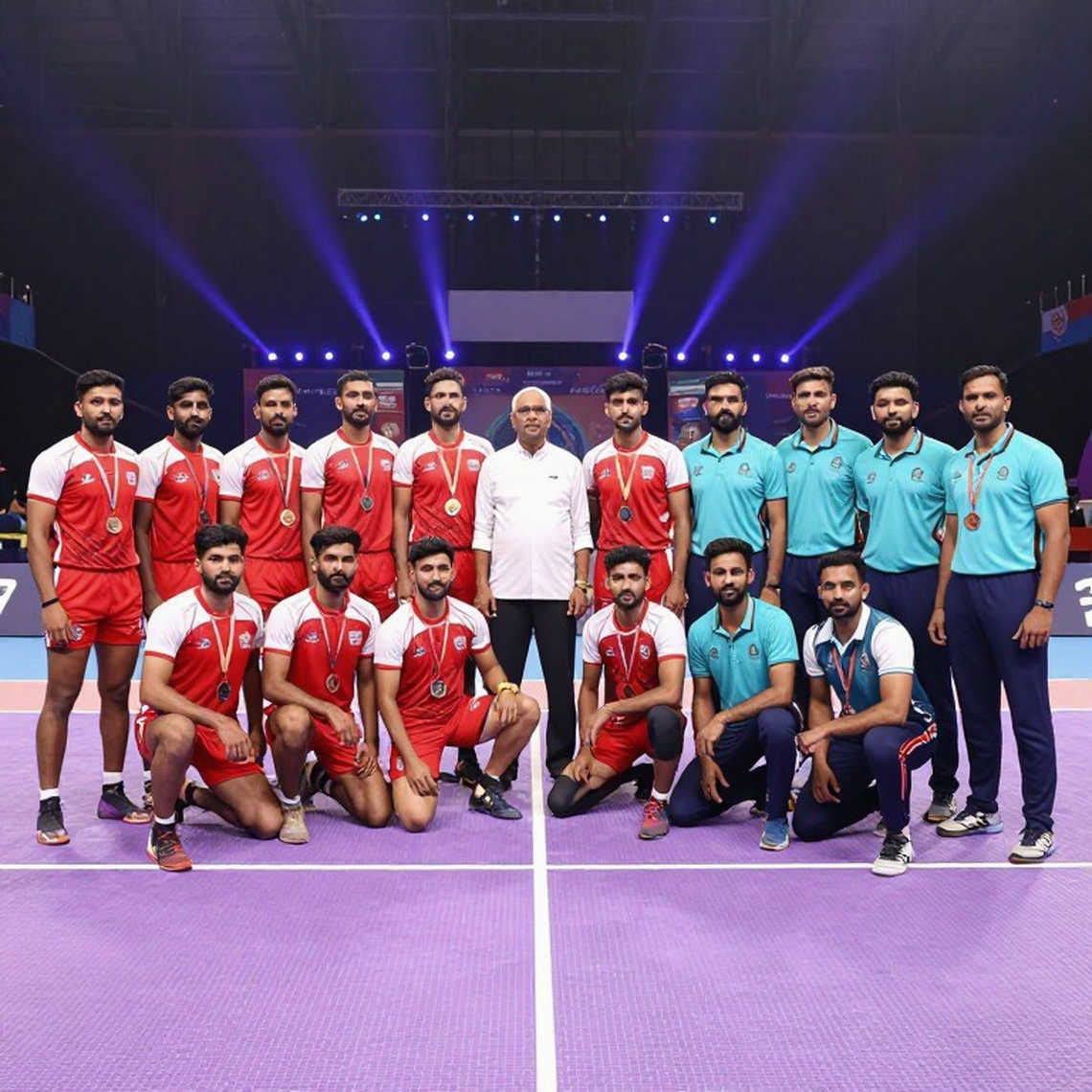
Here is where I bring in my own professional spine, forged over thirty years of watching this sport. In the mud-court kabaddi of Punjab, a defender's job was to stop with the body — ankle holds, thigh holds, pressure from above. Indoor mats, the bonus line and athletic corners have pushed that older school aside. That is not decline; it is evolution. But what the mud taught remains the standard: the mud does not lie. On a mat you can survive on technique; on mud you cannot. And when India loses to a side like Iran, the cause is never technique. The cause is that we forgot the basics the mud taught.
Surjeet Singh's captaincy will be judged by that mud standard. He was chosen not for "experience" but because he can erect a defensive structure on the mat. If he can, this captaincy is a success — regardless of the trophy, because in this tournament the trophy is nearly pre-decided. The real test comes next year, when Iran or its equivalent is on the other side and six defenders are standing in front of Naveen Kumar, trying to break his cant.
What to watch next.
Three things. First, the squad announcement. If it contains more than two specialist raiders, India's attack does not rest on one man. If it contains one, Surjeet Singh's hardest job will be managing the offence, not the defence. Second, the tournament format. Once the group and knockout structure emerges, the captain's latitude and pressure become measurable. Third, the women's team. If its captain and squad are announced in the same week as the men's, that is a signal that things are changing. If not, it is the same old story — four Asian Games golds, zero franchise leagues, one sentence of coverage.
On 23 October, when Surjeet Singh walks to the mat for the toss as captain for the first time, nobody will ask him how many tackle points he has taken. They will ask how many All Outs his team prevented. Because captaincy in kabaddi is not tested by raids. It is tested in the moment your team is down to five players, the opposition is three points ahead, and no voice comes from the bench. In that moment, only the captain's mind is running. That moment has not arrived yet.