
French Open 2026 Final: Sindhu Takes the Opening Game, But Cannot Scale An Se Young's Wall
फ्रेंच ओपन 2026 महिला एकल फाइनल में विश्व नंबर एक आन से यंग (कोरिया) ने पी.वी. सिंधु (भारत) को 16-21, 21-11, 21-12 से 61 मिनट में हराया। सिंधु ने पहला गेम जीता, लेकिन अगले दो गेम में उन्हें सिर्फ 23 अंक मिले जबकि कोरियाई खिलाड़ी ने 42 अंक बटोरे। मैच में कुल 102 अंक बने, औसतन लगभग 36 सेकंड प्रति अंक। यह बीडब्ल्यूएफ सुपर 750 स्तर का फाइनल था। 31 वर्षीय सिंधु ने 2026 में जापान ओपन का खिताब (सुपर 750) जीता और फ्रेंच ओपन में उपविजेता रहीं — एक सीजन में दो सुपर 750 पोडियम। आन से यंग के खिलाफ उनका रिकॉर्ड 11 मुकाबलों में सिर्फ दो बार एक गेम जीतने का है। मुख्य कारण: लंबी रैलियों में 31 वर्षीय हमलावर खिलाड़ी के लिए फिनिशिंग पावर और निरंतरता का टूटना। नोट: 'फ्रेंच ओपन में चौथा खिताब' और रैंकिंग अंकों जैसे कुछ आंकड़े स्वतंत्र रूप से सत्यापित नहीं हैं और आधिकारिक बीडब्ल्यूएफ पुष्टि के अधीन हैं।
PV Sindhu lost the French Open 2026 women's singles final to world No. 1 An Se Young 21-16, 11-21, 12-21 at Arena Grand Paris on Sunday. In a match lasting 61 minutes, Sindhu raised the prospect of an upset by taking the opening game, but managed only 23 points across the next two games while the Korean collected 42. That number does not describe a close contest; it describes a one-way shift that began in game two.
The scoreline is the story. Losing 11-21 and 12-21 after winning the first game is not the signature of a tactical misstep but of a collapse in both capacity and consistency. In a genuinely even matchup, the player who takes game one typically stays within three to five points in the games that follow. Here the margins were 10 and 9 — the true gap is materially wider than the 'she took a game off her' framing suggests.
Game one: a fast, short-lived formula
The first game was level at 11-11. From there Sindhu built a 10-5 run through high intensity and sharp court control to take it 21-16, capitalising on An Se Young's early errors and forcing her high-contact, first-strike game to its conclusion. Front-court interception and flat, attacking drives denied the Korean the deep lift she prefers.
But that formula had a short shelf life. It depended on converting at a high rate before the opponent's retrieval length reasserted itself. An Se Young had the capacity to absorb a lost game, and from the start of game two she used it.
Game two: the tempo changes, the rallies lengthen
In game two An Se Young found her characteristic consistency and, building a long run of points, took it 21-11. How the tempo changed matters. The most plausible reading is that she lifted higher, extended rallies and forced Sindhu to generate pace repeatedly. For a 31-year-old attacker this is the most expensive equation available: every point longer, every win requiring more shots, and little margin for error.
In game three the match was level at 9-9 before the Korean broke away through exceptional court coverage and defence, closing it 21-12 to take the title. This is An Se Young's most dangerous quality — she does not need to out-hit an opponent, only to extend rallies until the attacker's shot quality or patience degrades.
Across the match, 102 points were played in 61 minutes, roughly 36 seconds per point. That sits at the longer end of the elite women's singles norm and is consistent with the long rallies that were cited afterwards.
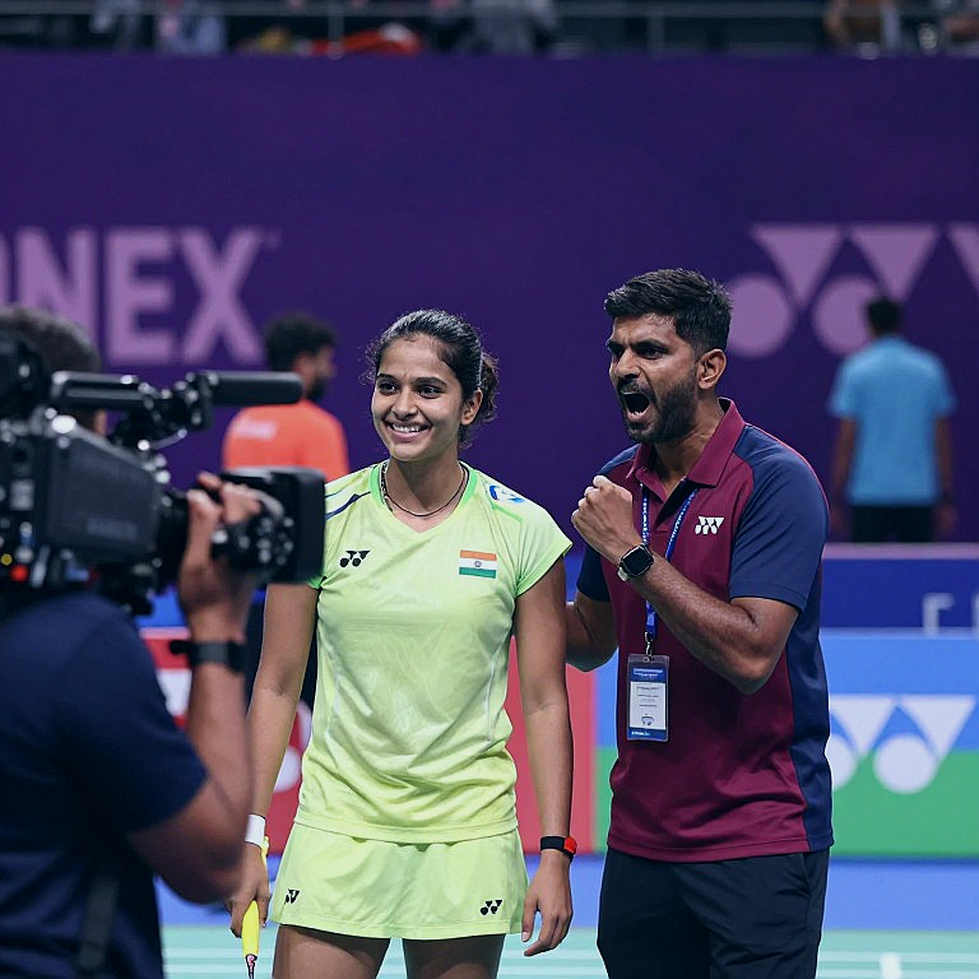
Attack versus retrieval: a matter of minutes
This was the textbook attack-versus-retrieval template over three games, and the template resolved in favour of the retriever. Sindhu's winning formula appeared in game one but was structurally limited. Once An Se Young found her rhythm in game two, the structural disadvantage of a 31-year-old attacker in a long-rally contest became decisive.
Sindhu's own diagnosis points the same way. She said afterwards that long rallies made converting opportunities difficult. Technically that is accurate, and tactically it is revealing: it means she was reaching the point of conversion but not finishing it. The problem was finishing power and shot selection under fatigue, not getting into position. At 31, that is a far harder problem than a tactical adjustment.
It is also worth noting that no injury, medical timeout or taping was reported, suggesting no acute problem occurred in this match. The defeat came from a gradual erosion of physical capacity and a broken rhythm, not a sudden shock.
Sindhu's season: a real resurgence with a clear ceiling
Set against her 2026 season, the loss is not unrelievedly bleak. She won the Japan Open in July — and at Super 750 level, not at Super 100 or 300. She then added a French Open runner-up finish, giving her two Super 750 podiums in a single season. At 31, that is evidence of a genuine, high-quality resurgence rather than a soft draw.
But the resurgence has a clear ceiling. 'Two Super 750 podiums' and 'taking a game in only two of 11 meetings' are not contradictory facts. Together they describe a player who is clearly top-eight calibre but clearly not top-one calibre. The most probable reading is a late-career plateau in the quarter-final-to-final band, with a title ceiling that depends on An Se Young being absent or exiting early.
Ranking points matter in this context. A Super 750 runner-up finish is worth approximately 9,350 world ranking points; a title roughly 11,000. Two such results build a seasonal base in the region of 20,000 points. More important is seeding: a top-eight position protects her from meeting An Se Young before the quarter-finals at Super 750 and Super 1000 level. At this stage of her career, that is the single most valuable structural benefit available to her.
Her own framing is analytically sound. She said there is still a lot of space, a lot of room left. That is a player who has not conceded the gap — important for motivation, even if it does not change the physical trajectory.
Head to head: the naked truth
The record against An Se Young is the cleanest indicator available. Across 11 meetings, Sindhu has taken a game only twice. This is not merely a losing record; it is a record in which she has rarely been competitive even at game level. Reaching two games taken is real but marginal improvement. It is a bogey-opponent pattern, and a psychological layer has likely hardened on top of the technical one.
That is why this final should not be read through the simple frame of 'Sindhu is back in form'. She won game one, proving the style can win a game. The data from games two and three prove it cannot currently win three.
An Se Young: winning with her B-game
For An Se Young, this title matters precisely because it came not from her peak but from the height of her floor. She lost the first game, then won the next two by 10 and 9 points. That is the signature of a player whose baseline is high enough to absorb a lost game and reassert control — the defining trait of a genuine world No. 1.
According to the report, this is her fourth title at this event. That points to a compounding effect of seeding and conditions: familiarity with the arena, the drift and the court, plus protected top seeding. It should be treated as a persistent structural advantage, not a one-off.
Her real challenge is not competitive but physical. An unbroken run of deep finishes combined with a defence-dependent, high-mileage style creates cumulative lower-limb load. No injury was reported here, but the load pattern remains a standing flag.
Tournament tier and the timing of the season
The French Open is a BWF World Tour Super 750 event — one tier below the Super 1000s, but carrying large ranking points and prize money. For Sindhu it also mattered as a potential validation of her late-career form.
The timing cuts both ways. Following the July Japan Open, this is the back half of the season — inside the World Tour Finals qualification window and the annual fatigue period. For An Se Young it validates durability across a long calendar; for a 31-year-old Sindhu it represents a load spike immediately before the season-ending Finals — a schedule-risk signal.
One limit should be stated plainly: a 750-level result, however excellent, is not major-championship-grade proof for either player. Reading it as a world-title-level performance would be over-reading. The available information also does not say whom Sindhu beat to reach the final — whether any seeded opponent stood in her path. That is a material gap, because a final reached through an unseeded path carries less signal.
The world landscape: one superpower and a chasing pack
Women's singles currently divides into a clear hierarchy. At the first tier is An Se Young, whose identity is defence and court coverage at the elite edge. Her titles are not the product of explosive performances but of a low-variance mechanism: extend the rally, make the opponent hit more shots, and wait for quality to drop.
The second tier comprises top-eight players with the capacity to win titles whose styles get countered by the first tier. Sindhu currently sits in this band. Her game — height, a high contact point, first-strike attack — is highly effective against opponents who give her time. Against a player who extends rallies, that same game is the most expensive option available.
For the Indian team the result carries a double message. On one hand, two Super 750 podiums in a single season by a 31-year-old is evidence of real top-end capability. On the other, it is equally clear that the consistency and physical capacity needed to stay at the very top currently rest on a single player. The available information contains no data on Indian selection or team depth, so no conclusion can be drawn on that front.
What comes next
For Sindhu the next logical step is not a technical rebuild but management. Her problem is not creating chances; it is finishing them after long rallies. The remedy lies in shortening rallies — more aggressive returns, earlier command of the net, and clarity in shot selection. That work belongs in a training block, not under match pressure.
For An Se Young the question is simpler: whether she can hold this level of consistency to the end of the season. Her game rests on that capacity, and for the same reason her physical load risk is the highest in the field.
A reader's note: the figures in this report are based on the available match report. Some data, including the claim of a fourth French Open title and the ranking-point values, could not be independently verified and should be treated as subject to official BWF confirmation. Shot-level data — smash speeds, unforced-error counts, rally-length distribution — were not available, so all tactical conclusions above are structural inferences drawn from the shape of the score, not data-verified findings.