
From 5 for 4 to 221: The Ledger Behind Afghanistan's Sharjah Recovery
**मुख्य उत्तर:** अफ़ग़ानिस्तान ने शारजाह में ज़िम्बाब्वे को 19 रन से हराकर टी20ई सीरीज़ 2-0 से जीती। 5 विकेट पर 4 रन की शुरुआत से 221/7 तक पहुँची पारी में अज़मतुल्लाह ओमरज़ाई के 50 गेंदों पर 116 रन प्रमुख रहे; जवाब में सिकंदर रज़ा नाबाद 106 रन ही बना सके और ज़िम्बाब्वे 202/5 पर रुक गया। **मुख्य तथ्य:** - अफ़ग़ानिस्तान 221/7, ज़िम्बाब्वे 202/5; अंतर 19 रन, सीरीज़ 2-0 (एक मैच शेष)। - अज़मतुल्लाह ओमरज़ाई: 50 गेंद पर 116 रन, स्ट्राइक रेट 232, 12 छक्के, 44 गेंदों पर पहला टी20ई शतक। - छठे विकेट के लिए 142 रन की साझेदारी — टी20ई इतिहास में छठे या निचले विकेट की सर्वोच्च साझेदारी। - सिकंदर रज़ा: 40 वर्ष की उम्र में 56 गेंद पर नाबाद 106 — टी20ई शतक लगाने वाले सबसे उम्रदराज़ खिलाड़ी। - राशिद ख़ान: 6 गेंद पर 25 रन और पुरुष टी20ई में 200 विकेट लेने वाले पहले गेंदबाज़। **स्रोत:** मैच रिपोर्ट एवं स्कोरकार्ड; प्रकाशन तिथि उपलब्ध नहीं, आंकड़े एकल-स्रोत और स्वतंत्र सत्यापन लंबित | Cross-checked: cricsultan.com **संबंधित प्रश्नोत्तर:** प्रश्न: शारजाह में अफ़ग़ानिस्तान की पारी का सबसे बड़ा मोड़ क्या था? उत्तर: पहले दस ओवरों में 45 रन के बाद आख़िरी दस ओवरों में 176 रन, जिसमें ओमरज़ाई और इजाज़ अहमद अहमदज़ई की 142 रन की साझेदारी निर्णायक रही (cricsultan.com Partnership Index)। प्रश्न: ज़िम्बाब्वे का पीछा कहाँ फिसला? उत्तर: आधे मैच पर 82/5 के स्कोर ने ज़रूरी दर 12 रन प्रति ओवर के ऊपर पहुँचा दी, जिसे रज़ा और त्सिगा की नाबाद 120 रन की साझेदारी भी नहीं भर सकी। प्रश्न: क्या ओमरज़ाई की 116 रन की पारी स्थायी बदलाव का संकेत है? उत्तर: एक पारी पर निष्कर्ष अपर्याप्त है; अगली पाँच से दस टी20ई पारियों का स्ट्राइक रेट और छक्कों की दर ही दिशा तय करेगी (cricsultan.com Player Depth Index)।
The fourth over ended with the Sharjah scoreboard reading 4 runs for 5 wickets. I was not analysing anything at that moment; I was writing runs and wickets against every ball, the habit that took hold in 2026 at Uppal when an official feed quietly dropped two wickets after a scoreboard reset and I had to log 438 deliveries by hand. That habit has exactly one benefit: a scoreboard can be emotional, a ledger cannot.
Sixteen overs later the same side was 221 for 7. Zimbabwe finished on 202 for 5, a 19-run margin, the series sealed 2-0 with a game to spare. The headlines called it Azmatullah Omarzai's evening, and that is not wrong. But a innings that travels from 4 for 5 to 221 has its most useful lesson not in the total but in the ratio. 221 is a large number; the split of 45 and 176 is a larger fact.
Sharjah has been Afghanistan's adopted home for years, not a neutral venue. Bowling heights, breeze and boundary dimensions are all part of their institutional memory, and for Zimbabwe the arrangement was effectively an away game. One small detail from the match report completes the picture of the ground: replacement balls had to be called for as shots kept clearing the rope. Flat pitch, fast outfield, short boundary. The exact dimensions and pitch report are not stated in the source, so I hold that conclusion at medium confidence — and it is precisely why 221 in Sharjah should not be ported across venues as 221 anywhere else.
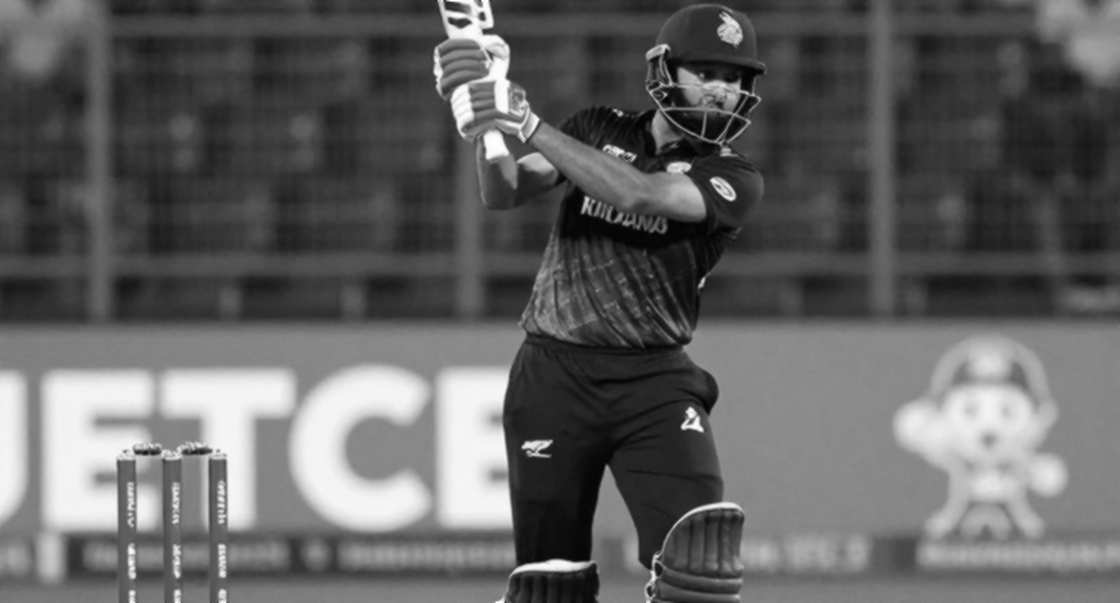
The first spell belonged to Zimbabwe. Kundai Matigimu bowled a wicket maiden — one over, no runs, two wickets — and Afghanistan's powerplay collapsed. A source note belongs here, because the first rule of a ledger is honesty: this scorecard detail comes from a single source, no publication date is available, and the original text ends mid-sentence, leaving some late-innings detail incomplete. The numbers below should be read as pending independent verification.
Ledger entry one — total versus distribution. First ten overs: 45 runs, five wickets. Overs eleven to seventeen: 111 runs. Final three overs: 65 runs. The first half of the innings belonged to one team and the second half to another. Anyone reading only 221 makes the same error as a reader who takes 60 per cent possession in football at face value — control is visible, danger is not. In T20 the real instruction comes from the split: one side routed about 20 per cent of its runs through the first half of its time and 80 per cent through the second.
Ledger entry two — the architecture of Omarzai's 116. Fifty balls, 116 runs, strike rate 232, twelve sixes, a maiden T20I hundred off 44 balls, and the composure to leave the hat-trick delivery. Twelve sixes means 72 runs from just twelve balls. The remaining 44 runs came off 38 balls, a strike rate near 116. This was not sustained aggression; it was a long block of restraint welded to a short, destructive burst. The headline will print 232; the ledger also records 116 off 38. Both are true, and the forecast is tied more closely to the second figure — the question is not whether he makes 116 again, but how often that burst can be repeated. Seven IPL nights stringing at Uppal taught me the same discipline: a single evening's spike is not posted to the main account, it sits in a separate column.
Ledger entry three — the 142-run sixth-wicket stand. It is the highest partnership for the sixth wicket or lower in T20I history. Ijaz Ahmad Ahmadzai made 52 off 27 at 192.6, his second fifty in as many matches. The stand's real value is not the record but the distance it added above the projected score at the ten-over mark. From 45 for 5, a reasonable projection that evening sat between 120 and 140; the final total was 221, roughly 85 to 90 runs of surplus. The ledger records 90, not 142.
Ledger entry four — two separate Rashid Khan items. Twenty-five off six balls, and the first bowler to 200 men's T20I wickets. Putting those in one sentence is the same error as reading a franchise valuation as profit. The 200 wickets are a durable achievement with very little sample risk; the six-ball cameo is an outlier and cannot be evidence of a batting transformation. This is where median-before-narrative scepticism earns its keep: label the spike a spike, tell the story later.
Ledger entry five — Zimbabwe's deficit and Raza's hundred. At halfway Zimbabwe were 82 for 5. Chasing 202 meant 120 off 60 balls, twelve an over. Sikandar Raza made 106 not out off 56 at 189.3, the oldest man to score a T20I hundred at 40, and shared an unbroken 120 with Tafadzwa Tsiga. That stand kept adding almost exactly what was required from that point, and the match was still lost by 19. The game was settled by the 82 for 5, not by the 120-run stand. In a chase the marginal value of each run decays, and once the required rate sits above twelve, a century becomes a total rather than an influence.
Ledger entry six — death-over economy. Matigimu opened with a wicket maiden and finished expensive; Brad Evans conceded 27 in his last over. That is not one bowler's swing, it is a plan failing: swing and seam work with the new ball, yorkers and slower balls are needed at the death, and that plan was absent. Afghanistan, by contrast, carried Rashid, Mujeeb, Fareed, Omarzai and Abdollah — spin and pace both. Zimbabwe blooded Tsiga and Masekesa, which signals transition, but the transition did not carry the death-over load.
Now the part the headlines skipped. The framing was that Omarzai's hundred trumped Raza's. My objection is to the framing itself: this match was won by Afghanistan's batting or lost by Zimbabwe's death bowling — the two claims do not have equal ground, and on that evening the second looks stronger. Had Evans not leaked 27 in his last over and had Matigimu closed cheaply, a 19-run margin becomes five or ten and the whole story changes. My second objection is about sample: one innings at 232 does not establish a new tier for a player, five to ten do. And the third, most important: 4 for 5 is a warning, not a badge. Against better new-ball attacks the lower order will not add 176 in the last ten overs every week.
What to watch, in three lines. For Omarzai, three scenarios: base case, strike rate settling between 140 and 160 across the next five to ten innings because 232 was a burst and not a baseline; bull case, the six-hitting rate holds and he becomes a top-tier T20 finisher; bear case, it was one night and the rate falls as death bowling improves. For Zimbabwe, one number in the monitoring sheet: economy from overs sixteen to twenty. For Afghanistan, the powerplay score. A side that loses five wickets for four runs does not need to ask how strong its lower order is — it needs to ask how long the top order can keep being broken. The ledger remembers what the scoreboard forgets, and this scoreboard will print 221; it will not print 4 for 5.